Lake Palestine Dock Permit Rules Buyers Should Know
August 27, 2026
August 27, 2026
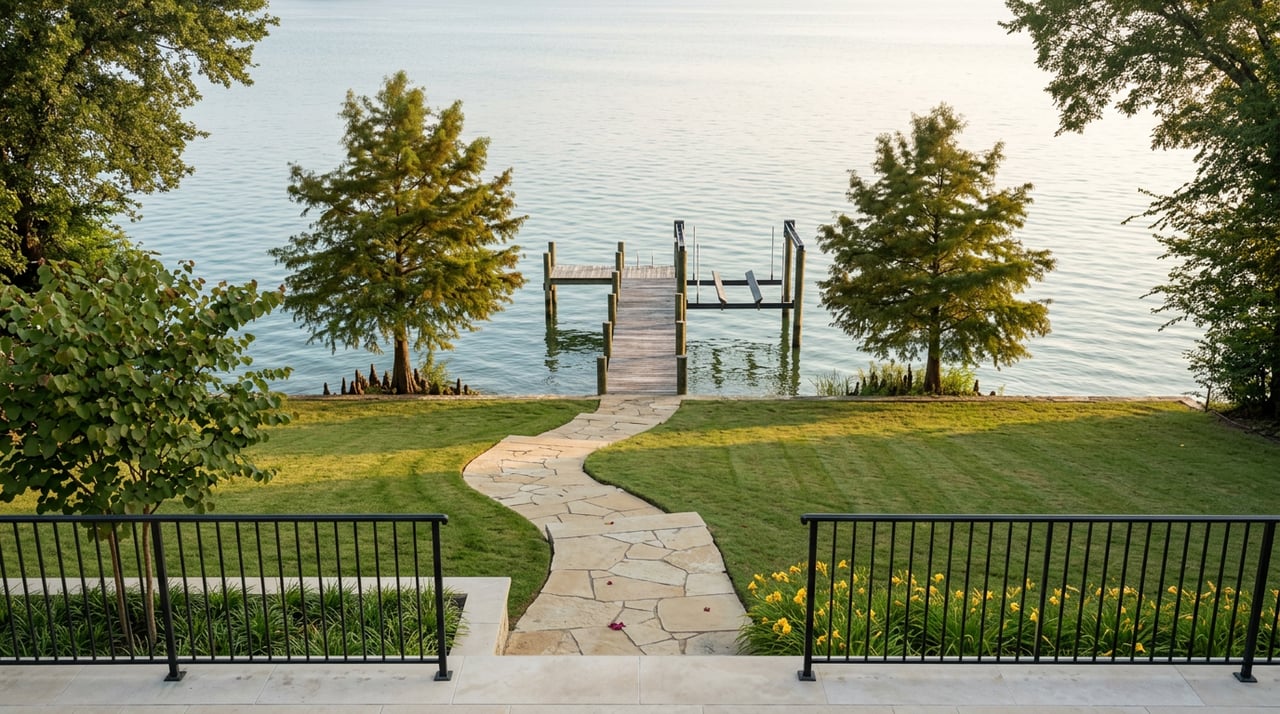
Every waterfront listing on Lake Palestine features the same hero shot: a covered boathouse, a boat lift, water stretching out behind a home that otherwise looks like any other well-kept property in Smith or Henderson County. Buyers read that photo the way they read the roof or the driveway. It is part of the house. It transfers with the deed.
It often does not work that way, and the gap between what the photo implies and what the paperwork actually says is where Lake Palestine closings run into trouble.
Lake Palestine is owned and operated by the Upper Neches River Municipal Water Authority, and UNRMWA holds the certificate of adjudication for the entire reservoir, not just the dam. Waterfront homeowners hold title to their upland parcel. The water surface, the lake bed, and the shoreline up to the takeline belong to the Authority. That distinction is the whole story here, because a dock, pier, boathouse, bulkhead, or fence placed on Authority land requires its own Limited Use Permit before it can legally exist, and owning the upland lot next to it does not grant an automatic right to build or maintain anything over the lakebed.
Most buyers never think to ask who owns the water in front of the house they are touring. On Lake Palestine, that question determines whether the dock in the listing photo is a legal fixture, a documented liability, or something in between.
Lake Palestine's takeline sits at 355.0 feet above mean sea level. Everything below that elevation, out to the reservoir's edge, falls under UNRMWA's authority rather than the adjacent landowner's. The lake itself spans Anderson, Cherokee, Henderson, and Smith counties, fed by the Neches River and held back by the Blackburn Crossing Dam, and each county layers its own building code on top of whatever UNRMWA requires. A buyer who assumes the dock is simply part of the lot is assuming a version of ownership Texas water law does not recognize on this reservoir.
There is also a water quality dimension that catches sellers off guard almost as often as the dock question does. Within 525 feet of the takeline, any on-site sewage disposal system falls under UNRMWA's Water Quality Zone authority and must be permitted by the Authority, a delegated function under Texas Commission on Environmental Quality rules that applies even to older systems installed before the requirement was formally codified. If a home's septic system sits inside that band, its permit status is a second, separate item for the due diligence list.
The word comes up constantly in conversations about older docks on this lake, and it is almost always used incorrectly. A boathouse built decades ago is not automatically exempt from today's rules simply because it predates them. UNRMWA treats significant reconstruction or enlargement as triggering current permitting standards, not the standards that existed when the structure first went up. Buy a property with an aging boathouse, plan to rebuild it for a bigger boat or a second lift, and you are not renovating under 1990s rules. You are applying under today's rules, on today's timeline.
That single fact reshapes how a buyer should think about any waterfront listing where the dock looks original to the house. The age of the structure is not protection. It is, at best, a starting point for a records request.
UNRMWA's Limited Use Permit runs $25 annually plus $0.05 per foot of shoreline frontage, with a separate construction permit fee of $50 per project. These fees cover the permit charges; the additional expenses involved in planning and building are listed below.
| Line item | What it actually covers |
|---|---|
| UNRMWA construction permit | $50 flat fee, administrative only |
| Limited Use Permit (annual) | $25 plus $0.05 per foot of frontage |
| Survey and topographic work | Confirms placement relative to the takeline and neighboring parcels |
| Structural engineering | Required for anything beyond a simple single-slip dock |
| Contractor mobilization and materials | Piling type, roof system, and site access |
| Utility connections | Electrical service to the structure, if applicable |
| Contingency | Water-level variability and regulatory review add real risk to a fixed budget |
Because fee schedules can change, treat the dollar figures above as a starting reference and confirm current amounts directly with UNRMWA before you build a budget or a closing timeline around them.
Here is the part that surprises even buyers who have closed on waterfront property before. The Texas Department of Insurance explains that title insurance protects against title defects, liens, and similar matters. It does not address whether a boathouse carries a valid UNRMWA construction permit, and it will not compensate anyone if the Authority later requires modification or removal of an unpermitted structure. That risk survives the transaction regardless of how many owners the property has passed through.
This means a title company can clear a Lake Palestine closing with no defects on record while the dock sitting fifty feet from the back porch has no permit file at all. The two facts are not in conflict. They are simply answering different questions, and a buyer who assumes a clean title report means a clean dock has confused the two.
Lenders and appraisers are catching up to this faster than most sellers expect. An appraiser who flags a non-conforming structure may discount the waterfront premium built into the price, and a lender may ask for permit documentation before releasing a mortgage commitment. A separate dock rider from a specialized carrier, typically running $1,000 to $5,000 a year depending on structure value, belongs in the first-year cost model rather than as an afterthought discovered at renewal.
Dock condition changes the calendar as much as it changes the budget. A clean, verified dock with no repairs needed can support a 30 to 45 day close without pressure on either side. A transaction involving moderate work, a new lift, an electrical upgrade, a roof repair, realistically runs 45 to 75 days once UNRMWA review and local permit intake stack up against contractor scheduling. A deal involving an unpermitted structure, an encroachment dispute, or a full rebuild can stretch to 90 days or beyond, which is a serious problem for anyone holding a rate lock or a fixed move date.
Open, fixed docks without walls or plumbing sit at the low end of that complexity range. Enclosed boathouses, anything with a living-space addition, and any structure that includes plumbing sit at the high end, and in some cases a substantially non-compliant structure is genuinely cheaper to demolish and rebuild under a fresh permit than to retrofit into compliance.
Buyers cross-shopping Lake Palestine against Lake Tyler often assume the two East Texas lakes run on similar rules because they sit less than half an hour apart. They do not. Lake Tyler falls under the City of Tyler's own code rather than a river authority, and the city has required building permits for all dock and boathouse construction since November 18, 2011, with anything built before that date treated as undocumented rather than grandfathered. On August 19, 2022, the City of Tyler permanently stopped issuing new boathouse plumbing variances, which means existing compliant boathouses remain capped at one commode, one lavatory, and a single shower, while new or substantially renovated structures cannot add any plumbing at all.
Lake Palestine has no equivalent blanket plumbing prohibition, though sewage facilities below the takeline face their own restrictions through UNRMWA's Water Quality Zone authority described above. The permitting bodies are different, the fee structures are different, and a due diligence checklist built for one lake will miss items that matter on the other. Anyone weighing the two lakes side by side should treat that as a genuinely separate research task, not a single lookup.
Does a Limited Use Permit transfer automatically to a new owner? Not necessarily. Some permits require a new application at the point of sale rather than a simple transfer, which is why confirming transferability with UNRMWA before closing matters more than assuming it based on how long the current owner has held the property.
What happens if UNRMWA finds an unpermitted dock after I already own the property? The Authority retains the power to require modification or removal of the structure regardless of how many owners it has passed through since it was built. Enforcement timing at any specific property is not predictable, which is exactly why pre-closing verification is worth the effort compared to hoping the issue never surfaces.
If you are weighing an offer on Lake Palestine waterfront, or preparing to list a property with a boathouse whose paperwork you have not looked at in years, that permit file is worth reviewing before either decision gets made public. I walk sellers and buyers through exactly this kind of documentation as part of every Lake Palestine transaction, alongside the design and staging guidance my clients already expect. You can see current Lake Palestine listings here, or reach out through Shauna Bright to schedule a private consultation before you write an offer or sign a listing agreement.
This article is general information, not legal, tax or financial advice. Consult a qualified professional about your situation.
Stay up to date on the latest real estate trends.
Whether its your first home, a larger property for your growing family or a scaled-down home for a comfortable retirement. Shauna’s combination of design experience, remodel and building experience, and real estate expertise makes her an individual partner who will exceed your expectations with outstanding service and results.
Shauna Bright
Address 7248 Crosswater Ste 100 Tyler TX 75703